Why this matters
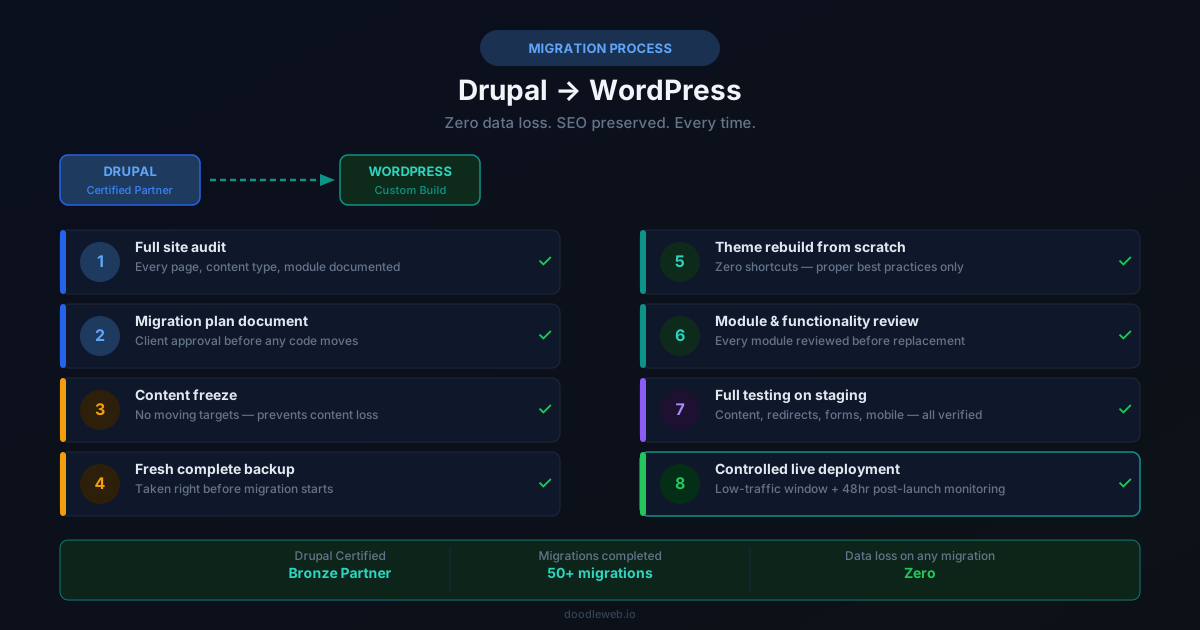
Most agencies skip half the steps in a Drupal to WordPress migration and clients end up paying twice. Here's the exact 8-step process DoodleWeb follows on every single migration — no shortcuts, zero data loss.
At DoodleWeb, we've worked with teams across Seattle and beyond who keep running into the same blockers around this topic. This post pulls together what we've learned — patterns that work, mistakes to avoid, and the specific moves we recommend when a client asks us about it.
The short version
If you only have two minutes, the headline is this: The Exact 8-Step Process We Use for Every Drupal to WordPress Migration is no longer a nice-to-have. It directly affects acquisition, retention, and how quickly your team can ship. Treat it like infrastructure, not a one-off project.
The teams getting this right share three traits:
- They invest in the foundation before chasing tactics.
- They measure outcomes, not deliverables.
- They keep iterating after launch instead of treating launch as the finish line.
What we typically see go wrong
Most of the failure modes we see fall into a handful of buckets:
- Scope sprawl. Teams try to solve everything at once and ship nothing.
- No clear owner. Strategy lives in one team, execution in another, and reporting in a third.
- Vanity metrics. Dashboards that look great but don't change decisions.
- One-and-done thinking. Spinning up a project, shipping it, and never revisiting.
A small amount of structure — clear goals, an honest baseline, and a 90-day plan — fixes most of this before it starts.
How we approach it
Our process for engagements like this generally runs in three phases:
/1. Audit and baseline
Before we touch anything, we measure. Performance, search visibility, conversion paths, accessibility, content gaps — whatever's relevant to the goal. This becomes the scoreboard.
/2. Build the right thing
We ship in tight loops with the smallest meaningful slice first. Every release is reviewed against the baseline so the team can see movement, not just activity.
/3. Operate and improve
Launch is the start. We stay paired with the in-house team on iteration, monitoring, and the quarterly roadmap so the work compounds instead of decaying.
What good looks like
Concretely, here's what we tell clients to expect from a healthy engagement:
- Core Web Vitals in the green on launch
- A documented, repeatable release process
- A measurement plan tied to revenue or pipeline, not just traffic
- A 90-day post-launch roadmap with clear owners
When to call us
If this resonates and you're already in motion, great — keep going. If you're stuck, or if you're staring at a backlog that's growing faster than your team can ship, that's exactly where we plug in. We can run a short discovery, give you an honest read on the situation, and either help directly or point you at someone who can.
A note on AI
Every project we ship now considers how it will appear to AI search engines and assistants. Schema, content structure, citations, freshness — these used to be SEO niceties. They're now table stakes for being discoverable in a world where ChatGPT, Gemini, and Perplexity sit between your customer and your website.
Wrapping up
The bar keeps moving. The teams that win are the ones that treat their web presence as a living product — measured, maintained, and continuously improved. If you'd like a second pair of eyes on what you're building, we're easy to find.
Seattle, WA
A full-service digital agency working in WordPress, Drupal, Shopify, Webflow, React, and React Native. We partner with universities, governments, and growing brands to ship sites and products that hold up after launch.