Home
Insights
ArrowBlogArrow
Vibe Coding: When It's Brilliant and When It's a Disaster
Calendar icon
Apr 6, 2026
Time
8
min.

Vibe Coding: When It's Brilliant and When It's a Disaster

Web Development
Web Design
Author icon
Posted By:
Chandan Sharma

The Hottest Trend in Development Has a Dark Side

If you've spent any time in developer communities in 2025 or 2026, you've heard about vibe coding. The idea is seductive: use AI tools to generate working code fast, iterate in real time, ship something functional in hours instead of weeks, and worry less about whether the underlying architecture is pristine. Just get it working. Feel the vibe. Build.

Some incredible things have been built this way. Founders have gone from idea to working product in a weekend. Solo developers have built tools that previously would have required a team. Internal tools that would have sat in a backlog for months got shipped.

But vibe coding has also quietly killed a lot of projects — and a few companies. Understanding when to embrace it and when to run the other way is one of the most important decisions a technical founder or developer can make right now.

What Is Vibe Coding, Really?

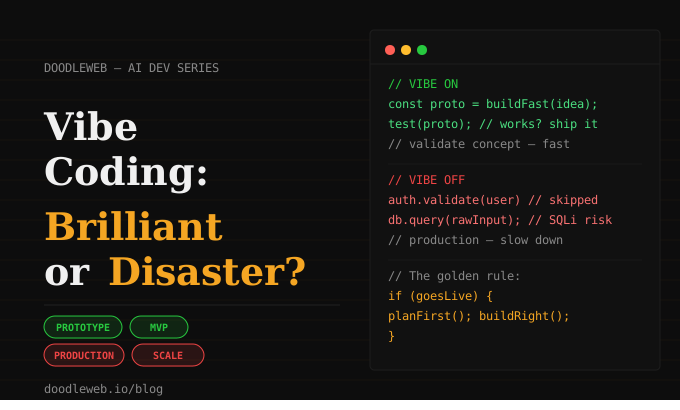
Vibe coding is a development philosophy that prioritizes speed of working output over code quality, architecture, and documentation. It typically involves heavy use of AI coding assistants — GitHub Copilot, Cursor, Claude, Replit Agent, and others — to generate substantial portions of code quickly, with the developer directing and iterating rather than writing from scratch.

The "vibe" part matters. Vibe coding isn't just AI-assisted development — it's a mindset that accepts imperfect code in exchange for velocity. You don't architect everything upfront. You don't write comprehensive tests. You don't document exhaustively. You build until something works, ship it, and deal with the debt later.

In the right context, this is genuinely brilliant. In the wrong context, it's technical debt that compounds until it collapses.

When Vibe Coding Is Exactly the Right Approach

Prototypes and Proof of Concepts

Nothing beats vibe coding for validating an idea. If you need to know whether a concept works — whether users actually want it, whether the technical approach is feasible, whether the business logic holds up — getting something working in 48 hours beats spending three weeks on a perfectly architected prototype nobody wants. Ship the vibe. Learn. Decide whether to invest properly.

Internal Tools With a Small User Base

An internal dashboard, a data processing script, a team-facing admin panel — these are perfect vibe coding candidates. The stakes are lower. If it breaks, the blast radius is limited. If it's ugly under the hood, the few people using it won't notice and probably don't care. Vibe-coded internal tools have saved hundreds of engineering hours for small teams.

Hackathons and Competitions

You have 24 hours. You need something impressive and functional. Vibe coding was basically designed for this scenario. Go fast, make it work, polish the surface, win.

Early MVPs Before Product-Market Fit

If you don't know yet whether your product is going to survive, you don't need production-grade code. You need something users can touch. Build the MVP at vibe speed, get real user feedback, and — if it's working — invest in rebuilding it properly. Many successful startups have done exactly this. The mistake is not rebuilding when the vibe-coded MVP starts to scale.

Personal Projects and Learning

Building something for yourself? Learning a new tech stack? Experimenting with AI? Vibe away. The only thing at risk is your own time.

When Vibe Coding Will Quietly Destroy Your Project

Client-Facing Production Applications

This is where vibe coding most commonly causes catastrophe. A client's production website or application has real users, real data, real business consequences, and real uptime expectations. Vibe-coded production systems often have:

  • Security vulnerabilities from skipped input validation and authentication shortcuts
  • Performance issues from unoptimized queries and missing caching
  • Fragile integrations that break when third-party APIs update
  • Undocumented dependencies that make maintenance a nightmare
  • No test coverage, making any change a gamble

DoodleWeb has inherited more than a few vibe-coded client sites. They're often impressive on the surface and terrifying underneath. The cost to properly stabilize them almost always exceeds what a disciplined build would have cost originally.

Anything Handling Financial Transactions or Sensitive Data

Payments, healthcare data, legal documents, personal identifiable information. If a security breach in your system has serious consequences for real people, vibe coding's tolerance for imperfect security practices is completely unacceptable. This isn't where you optimize for speed. This is where you slow down and do it right.

Platforms Expected to Scale

Vibe-coded architecture tends to be tightly coupled, hard to extend, and brittle under load. What works for 100 users frequently fails at 10,000. If you're building something with real scale ambitions, the architectural shortcuts that vibe coding encourages will create a ceiling you can't break through without a full rebuild — at the worst possible time.

Long-Term Products Requiring Ongoing Maintenance

Code that no one fully understands — including the person who wrote it — is a maintenance nightmare. Vibe-coded projects often lack the structure, naming conventions, and documentation that make a codebase navigable six months later. Every new developer you bring in will spend weeks reverse-engineering what the code actually does. Every bug fix carries a risk of introducing new ones.

Anything Requiring Accessibility Compliance

WCAG compliance doesn't emerge naturally from vibe coding. AI tools generate accessible code inconsistently. If your client requires ADA or WCAG 2.1 AA compliance — and for government, healthcare, and education clients this is non-negotiable — vibe coding is not compatible with that requirement without significant post-hoc remediation.

The Middle Path: AI-Assisted Disciplined Development

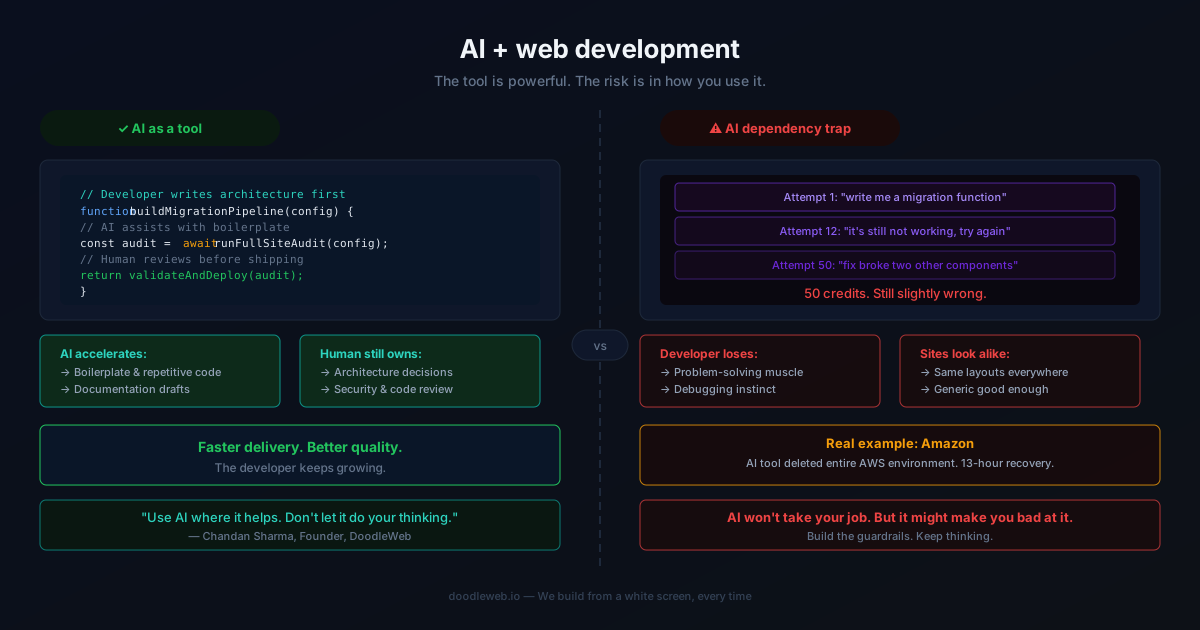
The best developers in 2026 aren't choosing between vibe coding and traditional development. They're using AI tools to accelerate disciplined development — generating boilerplate, getting unstuck quickly, exploring approaches, and drafting documentation — while maintaining architectural intent, code review, testing standards, and security practices.

This is how DoodleWeb builds. We use AI tools extensively to ship faster. We do not use them to skip the thinking, planning, and quality control that separates a working prototype from a production-grade system clients can rely on.

The Honest Framework: Ask These Questions First

Before you start vibe coding a project, ask yourself honestly:

  • Will real users with real expectations depend on this?
  • Does this handle sensitive data or financial transactions?
  • Will this need to scale significantly?
  • Will other developers need to maintain this in 12 months?
  • Does this need to meet compliance or accessibility standards?

If the answer to any of these is yes, slow down. Plan the architecture. Use AI tools to help you build it, not to replace the discipline that makes it trustworthy.

If the answer to all of them is no — prototype, internal tool, experiment, MVP — vibe away. The speed advantages are real and the downside risk is manageable.

BG hero

The Hottest Trend in Development Has a Dark Side

If you've spent any time in developer communities in 2025 or 2026, you've heard about vibe coding. The idea is seductive: use AI tools to generate working code fast, iterate in real time, ship something functional in hours instead of weeks, and worry less about whether the underlying architecture is pristine. Just get it working. Feel the vibe. Build.

Some incredible things have been built this way. Founders have gone from idea to working product in a weekend. Solo developers have built tools that previously would have required a team. Internal tools that would have sat in a backlog for months got shipped.

But vibe coding has also quietly killed a lot of projects — and a few companies. Understanding when to embrace it and when to run the other way is one of the most important decisions a technical founder or developer can make right now.

What Is Vibe Coding, Really?

Vibe coding is a development philosophy that prioritizes speed of working output over code quality, architecture, and documentation. It typically involves heavy use of AI coding assistants — GitHub Copilot, Cursor, Claude, Replit Agent, and others — to generate substantial portions of code quickly, with the developer directing and iterating rather than writing from scratch.

The "vibe" part matters. Vibe coding isn't just AI-assisted development — it's a mindset that accepts imperfect code in exchange for velocity. You don't architect everything upfront. You don't write comprehensive tests. You don't document exhaustively. You build until something works, ship it, and deal with the debt later.

In the right context, this is genuinely brilliant. In the wrong context, it's technical debt that compounds until it collapses.

When Vibe Coding Is Exactly the Right Approach

Prototypes and Proof of Concepts

Nothing beats vibe coding for validating an idea. If you need to know whether a concept works — whether users actually want it, whether the technical approach is feasible, whether the business logic holds up — getting something working in 48 hours beats spending three weeks on a perfectly architected prototype nobody wants. Ship the vibe. Learn. Decide whether to invest properly.

Internal Tools With a Small User Base

An internal dashboard, a data processing script, a team-facing admin panel — these are perfect vibe coding candidates. The stakes are lower. If it breaks, the blast radius is limited. If it's ugly under the hood, the few people using it won't notice and probably don't care. Vibe-coded internal tools have saved hundreds of engineering hours for small teams.

Hackathons and Competitions

You have 24 hours. You need something impressive and functional. Vibe coding was basically designed for this scenario. Go fast, make it work, polish the surface, win.

Early MVPs Before Product-Market Fit

If you don't know yet whether your product is going to survive, you don't need production-grade code. You need something users can touch. Build the MVP at vibe speed, get real user feedback, and — if it's working — invest in rebuilding it properly. Many successful startups have done exactly this. The mistake is not rebuilding when the vibe-coded MVP starts to scale.

Personal Projects and Learning

Building something for yourself? Learning a new tech stack? Experimenting with AI? Vibe away. The only thing at risk is your own time.

When Vibe Coding Will Quietly Destroy Your Project

Client-Facing Production Applications

This is where vibe coding most commonly causes catastrophe. A client's production website or application has real users, real data, real business consequences, and real uptime expectations. Vibe-coded production systems often have:

  • Security vulnerabilities from skipped input validation and authentication shortcuts
  • Performance issues from unoptimized queries and missing caching
  • Fragile integrations that break when third-party APIs update
  • Undocumented dependencies that make maintenance a nightmare
  • No test coverage, making any change a gamble

DoodleWeb has inherited more than a few vibe-coded client sites. They're often impressive on the surface and terrifying underneath. The cost to properly stabilize them almost always exceeds what a disciplined build would have cost originally.

Anything Handling Financial Transactions or Sensitive Data

Payments, healthcare data, legal documents, personal identifiable information. If a security breach in your system has serious consequences for real people, vibe coding's tolerance for imperfect security practices is completely unacceptable. This isn't where you optimize for speed. This is where you slow down and do it right.

Platforms Expected to Scale

Vibe-coded architecture tends to be tightly coupled, hard to extend, and brittle under load. What works for 100 users frequently fails at 10,000. If you're building something with real scale ambitions, the architectural shortcuts that vibe coding encourages will create a ceiling you can't break through without a full rebuild — at the worst possible time.

Long-Term Products Requiring Ongoing Maintenance

Code that no one fully understands — including the person who wrote it — is a maintenance nightmare. Vibe-coded projects often lack the structure, naming conventions, and documentation that make a codebase navigable six months later. Every new developer you bring in will spend weeks reverse-engineering what the code actually does. Every bug fix carries a risk of introducing new ones.

Anything Requiring Accessibility Compliance

WCAG compliance doesn't emerge naturally from vibe coding. AI tools generate accessible code inconsistently. If your client requires ADA or WCAG 2.1 AA compliance — and for government, healthcare, and education clients this is non-negotiable — vibe coding is not compatible with that requirement without significant post-hoc remediation.

The Middle Path: AI-Assisted Disciplined Development

The best developers in 2026 aren't choosing between vibe coding and traditional development. They're using AI tools to accelerate disciplined development — generating boilerplate, getting unstuck quickly, exploring approaches, and drafting documentation — while maintaining architectural intent, code review, testing standards, and security practices.

This is how DoodleWeb builds. We use AI tools extensively to ship faster. We do not use them to skip the thinking, planning, and quality control that separates a working prototype from a production-grade system clients can rely on.

The Honest Framework: Ask These Questions First

Before you start vibe coding a project, ask yourself honestly:

  • Will real users with real expectations depend on this?
  • Does this handle sensitive data or financial transactions?
  • Will this need to scale significantly?
  • Will other developers need to maintain this in 12 months?
  • Does this need to meet compliance or accessibility standards?

If the answer to any of these is yes, slow down. Plan the architecture. Use AI tools to help you build it, not to replace the discipline that makes it trustworthy.

If the answer to all of them is no — prototype, internal tool, experiment, MVP — vibe away. The speed advantages are real and the downside risk is manageable.

Not Sure If Your Codebase Was Vibe-Coded Into a Corner?

DoodleWeb offers technical audits for existing projects that aren't performing, scaling, or maintaining the way they should. Whether you're dealing with an inherited codebase, a fast-built MVP that needs to grow up, or a site that's starting to show its cracks — we'll tell you honestly what's there and what it would take to fix it. Start with a free website analysis at doodleweb.io/website-analysis.

CTA BG

Chandan Sharma

Dev Manager
Written By:

Chandan Sharma is a Web Development Manager and Coding Architect with an M.S. in Computer Science from The George Washington University and over 10 years of industry experience. He leads global teams to build secure, high-performance websites and web apps. Chandan is passionate about transforming complex ideas into seamless digital solutions.

Frequently Asked Questions

Rounded BG
No items found.